


Canada’s Rare Earth Ambitions Face Long Odds—but Momentum Is Building

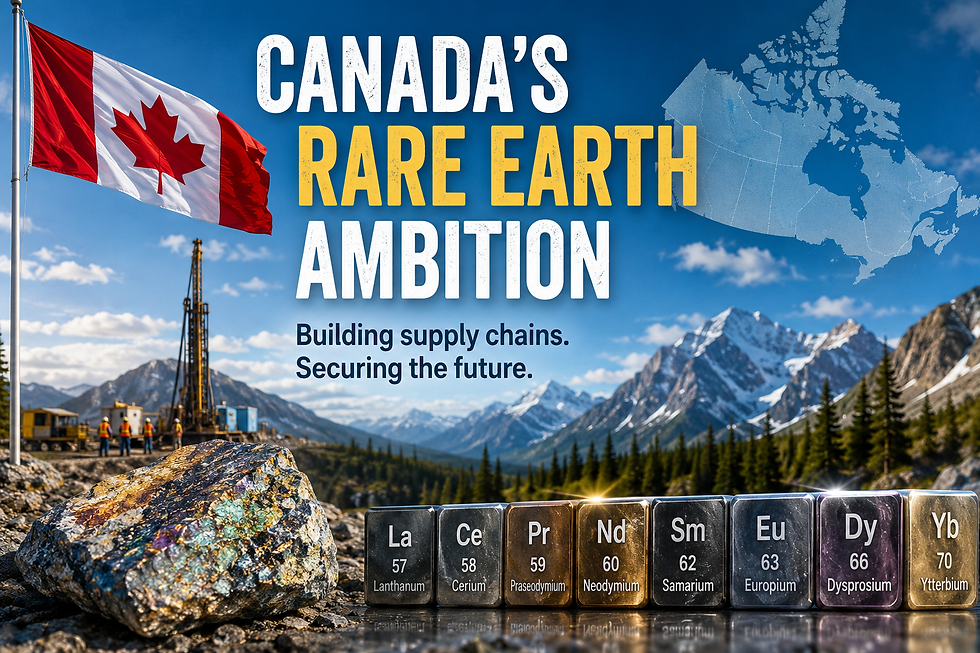
As global governments race to secure critical mineral supply chains outside China, Canada is positioning itself as a potential player in the rare earth sector. Yet despite growing political support and industry interest, the country remains in the early stages of developing a domestic rare earth mining and processing industry.
Speaking at the Prospectors & Developers Association of Canada (PDAC) convention, David Menendez, Global Vice President of Metallurgy and Consulting at SGS, outlined both the opportunities and challenges facing Canada’s rare earth ambitions.
Rare earth elements have become increasingly important due to their role in advanced technologies, electric vehicles, renewable energy systems, and defense applications. While demand continues to rise, China currently dominates the global market, controlling roughly 90 percent of rare earth refining capacity.
Outside China, only a handful of major projects have reached commercial scale. Menendez pointed to Australia’s Lynas and the United States’ Mountain Pass operation as the leading examples of successful rare earth production and processing outside Chinese control.
That dominance has prompted governments across the G7 to seek alternative supply chains.
“Rare earths get a lot of attention because they could become a constrained supply chain and because they are so closely tied to defense,” Menendez said.
Canada’s challenge is that it lacks a mature rare earth industry. While the country has thousands of gold projects in various stages of development, Menendez estimates there are only about 15 visible rare earth projects nationwide, with roughly half currently in the study phase. However, recent policy changes may begin to shift that landscape. Canada has expanded support for critical minerals through new government initiatives, including a $2 billion Critical Minerals Infrastructure Fund and measures tied to the Defense Production Act. Those tools allow governments to consider strategies such as offtake agreements, price support mechanisms, and strategic stockpiling.
The goal is not only to secure domestic supply but also to strengthen supply chains among allied nations.
“Canada has what the world wants,” Menendez said, pointing to growing cooperation among G7 and NATO countries as geopolitical tensions increase and governments seek to reduce dependence on China.
One recurring criticism of Canada’s resource sector is the slow pace of project development. Menendez referenced Neo Performance Materials as an example of what can be achieved when industry secures strong customer commitments.
The Toronto-based company recently completed a rare earth magnet facility in Estonia in approximately 500 days after securing support from automotive manufacturers willing to diversify their supply chains.
According to Menendez, obtaining long-term offtake agreements was critical to justifying the investment.
That type of collaboration may be necessary if Canada hopes to build a competitive rare earth ecosystem. Unlike larger industrial economies, Canada’s domestic demand alone is unlikely to support large-scale development. Success will depend on attracting foreign direct investment and securing partnerships with manufacturers abroad.
Government officials have recently emphasized both objectives. Prime Minister Mark Carney and Natural Resources Minister Tim Hodgson have repeatedly highlighted Canada’s resource potential while promoting efforts to strengthen domestic processing capabilities and attract international capital.
The federal government recently announced projects it believes could unlock approximately $12 billion in investment across the critical minerals sector. Industry participants say activity is already increasing behind the scenes.
Since critical minerals were brought under the Defense Production Act framework, Menendez says discussions between industry leaders, Natural Resources Canada, and defense officials have intensified. Mining companies, project developers, and service providers are increasingly collaborating on strategies to accelerate sector development. Major producers are also beginning to adapt. Menendez noted that Agnico Eagle, Canada’s largest mining company by market value, recently established a critical minerals business unit, signaling growing interest beyond traditional commodity sectors such as gold.
While rare earth development remains at an early stage, momentum appears to be building. The combination of geopolitical urgency, government support, foreign investment interest, and industry engagement has elevated rare earths from a niche mining topic to one of the most closely watched segments at PDAC. Whether that momentum translates into operating mines and processing facilities remains to be seen. But as governments and manufacturers search for alternatives to China’s dominant position, Canada is increasingly determined to become part of the solution.


Comments